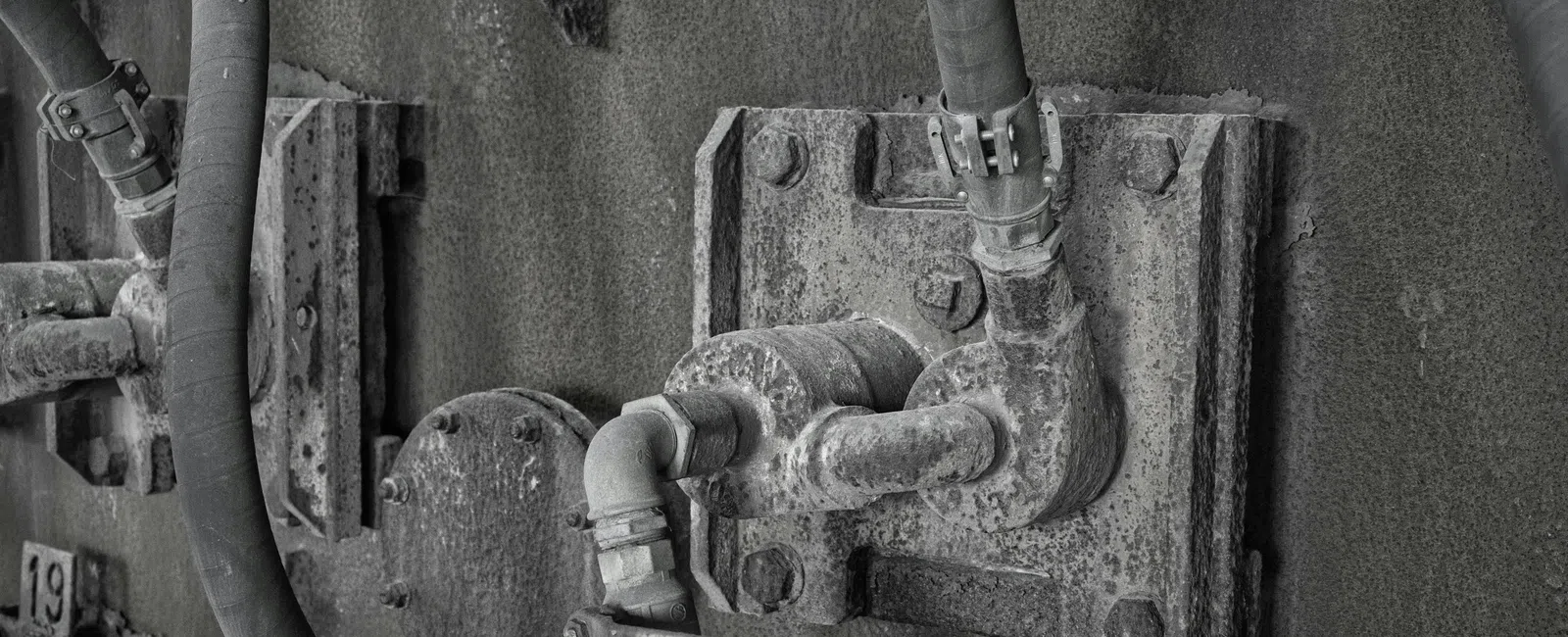
If your home was built before the mid-1970s, the drain lines running under your floors and out to the sewer are almost certainly cast iron. That material was the standard for decades because it was strong, quiet, and fire-resistant. What it was never designed to be was permanent. Cast iron drain pipe has a working life of roughly 50 to 80 years, and many of the houses in Decatur, Brookhaven, East Cobb, Marietta, and Fulton are now sitting at the far end of that range.
Cast iron does not burst the way a supply line does. It corrodes from the inside out over decades, and by the time a homeowner notices a problem, the pipe has usually been deteriorating for years.
How Cast Iron Actually Fails
Waste water is mildly acidic, and it sits against the interior wall of the pipe every time a fixture drains. Over years, that reaction builds a rough layer of scale and rust on the inside surface. Scale catches solids, solids slow the flow, and slower flow means waste sits in contact with the pipe longer. The process accelerates itself.
There are two distinct problems that come out of this:
The first is narrowing. A four-inch line can lose half its interior diameter to scale, which produces chronic slow drainage that no amount of snaking permanently fixes.
The second is channeling, where the bottom of the pipe corrodes completely through while the top still looks intact. A camera inspection of a channeled line shows a trough of open soil where the pipe floor used to be.
Why Georgia Soil Makes This Worse
Metro Atlanta sits on red clay, and clay behaves differently than the sandy soil that most national plumbing content assumes. It swells when saturated and contracts when dry, and it does this seasonally, every year, for the entire life of the pipe.
That movement puts constant stress on cast iron joints that were packed with oakum and lead when the house was built. Joints that would stay seated in stable ground work loose here. Clay also drains poorly, so when a line does develop a leak, the water does not disperse. It pools against the foundation and around the pipe, which speeds up exterior corrosion and can undermine the soil supporting a slab. The interaction between aging pipe and shifting clay is a large part of why cast iron in this region fails on the earlier end of its expected range.
Be Cautious of the Warning Signs
Most of these look like ordinary drain problems in isolation. The pattern matters more than any single symptom, particularly the ones that keep returning after a cleaning.
Symptom |
What it usually means |
Repair or replace |
Slow drains in multiple fixtures at once |
Scale buildup has narrowed the pipe interior, often to half its original diameter |
Camera inspection first. Descaling may buy time, replacement if walls are thin |
Recurring backups in the lowest fixture |
Channeling, where the pipe bottom has corroded through and waste sits in soil |
Replacement of the affected section |
Sewage odor with no visible leak |
Cracked or separated joint venting gas into the crawl space or slab |
Locate and replace the failed joint |
Damp spots or sunken flooring above a slab |
A failed under-slab line saturating soil beneath the foundation |
Replacement, usually with rerouting to avoid repeat excavation |
Rust flakes or dark debris in standing water |
Active interior corrosion shedding material into the flow |
Inspection to grade remaining wall thickness |
The signal that separates aging cast iron from a routine clog is repetition. A clog is an event, but a failing line is a pattern, where the same fixture backs up every few months regardless of how carefully the household treats the drains.
Getting an Accurate Diagnosis
There is no way to grade cast iron from the outside. The only reliable method is a camera inspection, which sends a video line through the pipe and shows the actual interior condition: how much scale has accumulated, whether the pipe floor is intact, where joints have separated, and whether roots have found a way in through a failed seam.
A camera run also tells you something a visual inspection cannot, which is how much of the system is affected. Homeowners often assume one bad section means one repair. In a house where every line was installed the same year from the same material, one failure usually means the rest of the system is close behind. Knowing that before work starts is what keeps a project from turning into three separate excavations. Our sewer camera inspection blog covers what the footage reveals in more detail.
Repair, Descale, or Replace
Not every aging cast iron line needs to come out immediately. The right call depends on remaining wall thickness and how much of the system shares the same condition.
Approach |
Best suited for |
Limitations |
Spot repair |
A single failed joint or short damaged run in otherwise sound pipe |
Does nothing for the rest of a line that is the same age |
Descaling and hydrojetting |
Heavy scale in pipe that still has solid wall thickness |
Restores flow but does not add life to thin or channeled pipe |
Full replacement with PVC |
Lines with channeling, multiple failures, or 60-plus years of service |
Requires excavation or slab access, higher upfront cost |
Descaling through hydrojetting is worth considering when a camera shows heavy buildup but a structurally sound pipe. High-pressure water strips the scale layer and restores the original diameter, which can add years to a line that is narrowed but not compromised. On a channeled pipe, it accomplishes nothing, because the problem is missing material rather than accumulated material. That distinction is exactly why the camera comes first.
What Replacement Involves
Replacement swaps cast iron for PVC, which does not corrode and is not vulnerable to the acidic waste that destroys iron over time. For lines in a crawl space, access is straightforward, and the work moves quickly. For lines under a slab, the pipe has to be reached by cutting through concrete or, in some cases, rerouted to avoid the slab entirely.
Rerouting is worth asking about. Running a new line around the slab rather than through it costs more in materials and labor but eliminates the risk of a future failure requiring another concrete cut. In a house where the remaining cast iron is the same age as the section being replaced, that tradeoff often favors the reroute. Our sewer and drain team will walk through both options against what the camera footage shows before any work begins.
One thing to watch during the process: a failing drain line and a hidden water leak produce overlapping symptoms, including damp flooring and unexplained moisture. If your water bill has climbed alongside the drainage problems, both systems deserve a look.
Frequently Asked Questions
How do I know if my house has cast iron pipes?
Construction date is the strongest indicator. Homes built before roughly 1975 almost always used cast iron for drain, waste, and vent lines. If you have crawl space or basement access, cast iron is dark gray, dull rather than shiny, and magnetic. Tapping it produces a dead thud rather than the hollow sound of PVC.
Do cast iron pipes always need to be replaced?
No. Age alone does not condemn a line. Some cast iron installed in the 1960s still has usable wall thickness, particularly in lines that carried lighter loads. What determines the answer is the camera inspection, not the calendar. A line with intact walls and heavy scale is a candidate for descaling. A line with channeling needs replacement regardless of how recently it was installed.
Can cast iron pipe be repaired instead of replaced?
A single failed joint or a short damaged section can be cut out and replaced without touching the rest of the line. This makes sense when the surrounding pipe grades out in good condition. It makes less sense when the entire system was installed at the same time from the same material, because a spot repair in that situation tends to be followed by another one within a couple of years.
How long does cast iron pipe replacement take?
Crawl space work on a single line often finishes within a day. Under-slab replacement takes longer because of the concrete cutting, excavation, and restoration involved, and whole-house replacement in an older home can run several days. The camera inspection is what allows an accurate estimate rather than a guess.
Is cast iron pipe replacement covered by homeowners insurance?
Coverage generally applies to sudden damage rather than gradual deterioration, and cast iron corrosion is by definition gradual. Some policies cover the resulting water damage even when they exclude the pipe itself. Your carrier is the authority here, and a written estimate plus camera footage documenting the condition will help with any claim you file.
Find Out What Condition Your Drain Lines Are Actually In
RooterPLUS! has served metro Atlanta since 1994, and our licensed technicians have inspected drain lines in more than 100,000 homes across the region. We will camera your line, show you the footage, and give you a written estimate before any work starts.
Call 770-962-9962 or schedule service online.